Framing the uses of AI at a strategic level
Structure the practices and internal processes to integrate AI methodically, responsibly, and with professional consistency.
In environments where professional responsibility is at stake, the issue goes beyond the tool.
On the ground, a reality is emerging: the uses of AI are developing, but remain poorly regulated.
Without a clear framework, practices become scattered.
Decisions are made in urgency.
Accountability weakens.
It is not just about integrating artificial intelligence.
It is about understanding how she fits into the work,
and what this entails for the teams, the decisions, and the deliverables.
“I support managers, executives, and team leaders in organising their work practices, clarifying their processes, and integrating AI within a controlled professional framework.”
I design educational tools to prepare academic teams and future professionals to integrate these issues into their practices.

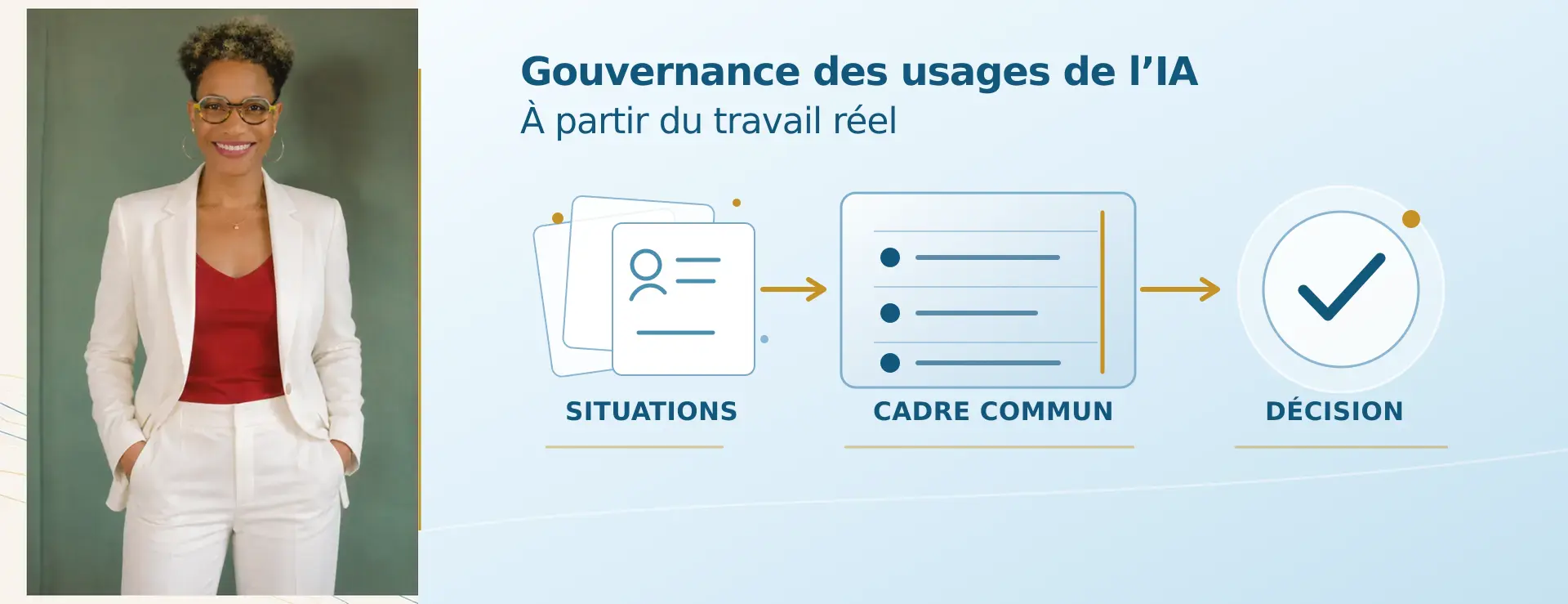
My work focuses on the organisation of work, the clarification of processes, and the governance of professional uses of AI.
I operate in environments where decisions directly impact practices, responsibilities, and the quality of the work produced.
On the ground, I often observe the same starting point: the tools are present, the uses are emerging, but the processes remain poorly clarified.
It is in this space that I intervene: framing the uses, structuring the practices, clarifying the decisions, and integrating AI within a controlled professional framework.
This approach is aimed at organisations, management, executives, and educational teams who want to prepare for usage without separating AI from real work.
She finds a particular grounding in design offices, architectural firms, engineering structures, and construction companies, where technical rigor, deliverables, and responsibilities shape every decision.
What I observe in the field
In many organisations, artificial intelligence is already being used.
Often at individual initiative, without a shared framework and without explicit alignment with the strategy.
Practices are advancing at different paces.
Work processes sometimes remain poorly clarified, roles overlap, and responsibilities become more difficult to manage.
The issue of professional responsibility arises very quickly.
During a seminar bringing together executives, one of them summarised the situation:
"If we don't establish a framework, everyone will use it their own way."
Without shared rules, clearly defined processes and accountable decision-making, professional practices become fragmented.
Accountability weakens.
Accountability
An engineer once told me:
"AI does 90% of the work, but I remain accountable."
AI can assist.
The final responsibility remains human.
Internal Organisation
Teams are experimenting.
Yet few know who decides, who validates and who ultimately takes responsibility.
Without clearly defined roles, AI practices remain individual.
AI adoption only becomes collective when accountability is explicitly established.
Governance
The conversation quickly becomes organisational.
AI is no longer just a technology. It becomes a decision-making framework.
Artificial intelligence becomes a governance issue.
At this point, an organisation either strengthens its structure—or weakens it.
What I Help Organisations Structure

I help organisations integrate artificial intelligence by starting from their real-world practices, operational realities and business constraints.
Together, we establish a clear framework for AI use, clarify work processes, identify critical points of attention and define responsibilities related to decisions, deliverables and data.
The objective: explicit, shared and operational AI integration.
Structuring Professional Practices and Work Processes
Successful AI integration depends on clear decisions:
- who uses AI, under which conditions, and with what level of validation.
- It requires shared rules and clearly assumed decision-making.
In practice, this means:
- establishing clear rules of engagement;
- providing consistent guidance to teams;
- making decisions that secure professional practices;
- aligning strategy, AI use and accountability.
A Smooth Integration
When the framework is clear, AI adoption progresses consistently.
Without it, practices quickly become fragmented.
SMEs
In small and medium-sized organisations, this structuring is often led directly by senior management.
It may also be carried by a team leader or an internal champion, whether formally appointed or naturally recognised.
In these organisations, every decision has a direct operational impact. AI cannot be treated as a peripheral topic.
An Approach Built Around Your Reality
AI does not exist in isolation.
It becomes part of a living organisation, with its own constraints, responsibilities and ways of working.
1. A Clarification Session
Before making any recommendation, we begin with a 30-minute conversation to understand your context, challenges and the questions raised by AI integration.
I ask targeted questions.
I listen.
I analyse the organisational, operational, human and process-related factors shaping your situation.
This is a time for understanding—not prescribing.
Depending on the complexity of your situation, an initial direction may emerge immediately or lead to a structured proposal.
2. A Tailored Engagement
Based on this understanding, I design an approach that reflects your organisation, your work processes and your real-world practices.
There is no predefined format.
Everything is built around your business context and your leadership team's level of commitment.
Possible formats include:
- a strategic leadership seminar;
- a targeted organisational assessment;
- a structured support programme over time;
- an intervention with your teams or internal champions;
- or another fully tailored format.
Observed Outcomes
Transformation is not measured by the number of AI tools deployed.
It is measured by the quality of the decisions, processes and accountability that surround those tools.
Before our work together, many organisations describe the same situation: individual experimentation, isolated initiatives, unspoken uncertainty.
AI is already circulating.
Strategic reflection is not.
The issue is rarely a lack of motivation.
It is a lack of a shared framework.
Transformation is not about moving faster.
It is about making practices safer, clarifying responsibilities and structuring decision-making.
What Should We Do?
One team leader summed it up perfectly:
"I don't know whether I should approve it, prohibit it or encourage it."
When expectations are unclear, decisions rely on intuition.
Intuition cannot replace governance.
Sharing Experience
Another manager explained:
"We're experimenting, but we don't have a space to discuss it together."
Without a structured space for dialogue, everyone progresses within their own perimeter.
Practices evolve. Learning does not.
After a structured approach is in place, organisations gain greater consistency.
Roles become clearer.
- Decision-making responsibilities are defined.
- An internal AI lead is identified where appropriate.
- Work processes become explicit.
- Professional practices are openly discussed and shared.
- Sensitive issues relating to data and deliverables are addressed.
Decisions are no longer isolated initiatives.
They become part of an agreed organisational framework.
AI is no longer an implicit subject.
It becomes a strategic one.

Un point d’entrée pour reprendre la main
CAP Dirigeant
Un temps décisionnel de 90 minutes pour reprendre la main sur vos usages de l’IA.
Dans certains contextes, le sujet ne peut plus rester en suspens : des usages apparaissent, des outils sont testés, des questions émergent, mais aucun cadre clair n’a encore été posé.
CAP Dirigeant permet de faire le point, clarifier les priorités, identifier les premiers usages utiles et poser un premier cadre d’intégration de l’IA dans le travail réel.
Ce format s’adresse aux dirigeants, cadres, responsables d’équipe et indépendants qui souhaitent prendre du recul avant d’engager un travail plus structuré.
Il est particulièrement utile lorsque vous souhaitez :
- comprendre où vous en êtes réellement ;
- éviter d’empiler des outils sans cadre ;
- identifier ce qui peut être allégé, automatisé ou sécurisé ;
- clarifier les décisions qui doivent rester sous responsabilité humaine ;
- poser les premiers arbitrages avant d’aller plus loin.
À l’issue de la séance, vous repartez avec une lecture plus claire de votre situation, des priorités mieux posées et des premiers axes de décision activables.
90 minutes
450 € HT
Visio Google Meet ou présentiel dans vos locaux
1 à 4 participants maximum
Demander un créneau CAP Dirigeant
Un court questionnaire permet de préparer la demande. Le créneau est confirmé après validation et règlement préalable.
Strategic Conversation
If your leadership team would like to address artificial intelligence as an organisational, process and governance issue, let's take the time to clarify your situation.
This first conversation helps identify your challenges, understand current AI practices and determine the decisions that need to be made.
Get in touch
+596 696 37 66 90

Latest Insights
Explore the latest articles, field observations and reflections published by PAS À PAS DIGITAL.